
“It is challenging looking after someone. I know all of my friends are out doing something together, while I cook dinner and care for my Grandma. I don’t mind but it can be very isolating.”
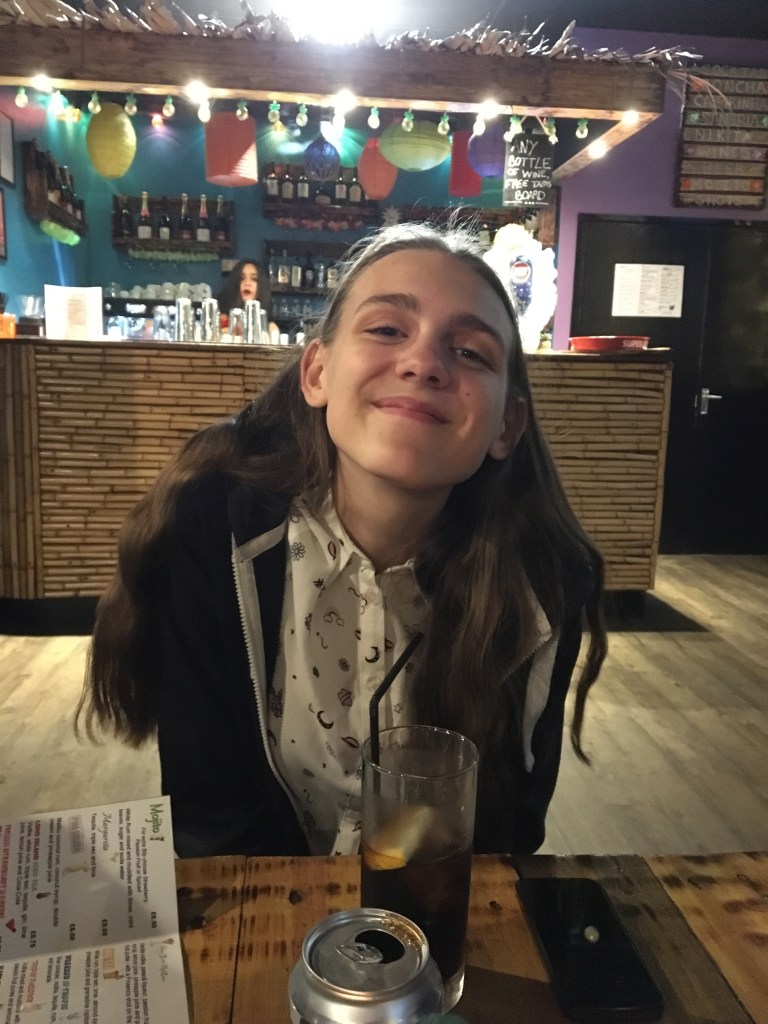
Lillie Gray is 15 and cares for her Grandma who has dementia.
She has been caring for her Grandma Peggy, since she was 12. This was when Peggy first became ill with dementia in 2017, which resulted in her moving in with Lillie and her mother Michele.
Michele works full time, including night shifts as a nurse in order to provide for Lillie and Peggy, as they live together in Barnsley. Lillie’s father has not been in the picture since her birth. Michele is an only child. This leaves Lillie to care for her grandma before and after school.
“My grandma requires help everyday. I mostly help her shower and get dressed every morning as my mum is already at work. I make her porridge as it’s the only thing she likes anymore.”
With the population ageing, the number of dementia cases is rising. According to Alzheimers.org. 225,000 people will get dementia this year, adding onto the total of 850,000 who already have it across the UK. With this rise in cases, the number of young carers is expected to rise with it. The National Children’s Bureau states that there are no figures to see just how many young people are caring for loved ones with dementia or how it can impact their mental well being.
In 2018, the BBC reported that “there are as many as 800,000 young carers in England, with six being in every secondary school classroom. A survey completed by 925 children from two year groups, 11-12 year old and 14-15 year olds, saw 22% cared for a relative with an illness or disability of those, 32% were classed as doing a high level of caring.” From this the report suggests if the “survey was extrapolated across England it would correspond to more than 800,000 secondary-school age children carrying out some level of care.”
“It can be hard sometimes.” says Lillie, “With my gran not being who she was. I almost don’t have time to grieve what we lost. It gets me sometimes. Mentally it’s draining and I notice sometimes that I’m not as upbeat and chatty as most of my friends are at school.”
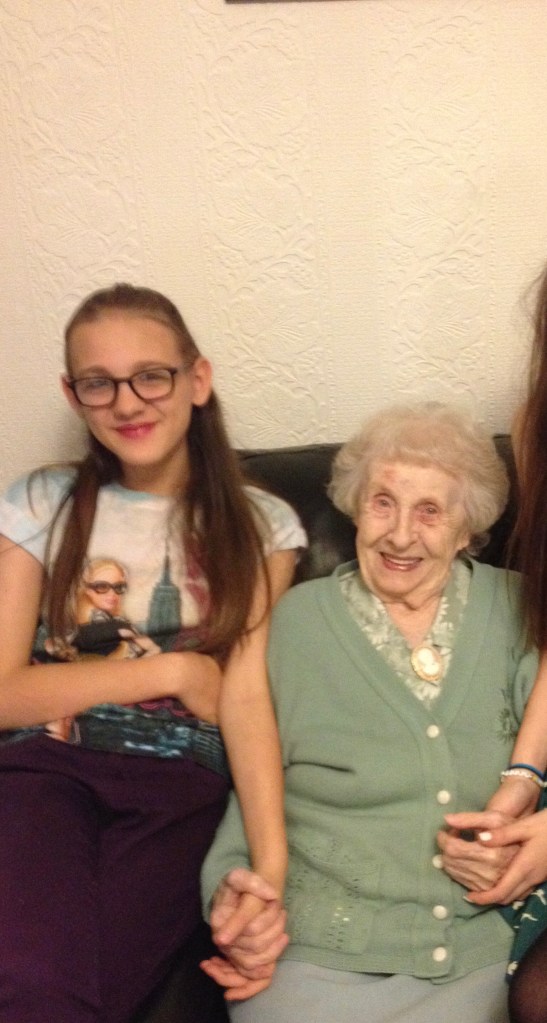
Lillie’s grandma is in stage 3 of dementia, which falls into the severe category. Meaning Peggy is in the end stages of her life, at the age of 86.
“She doesn’t know who me and my mum are at this stage. This also means that she cannot do anything for herself, she has lost the ability to walk, talk or feed herself.”
When Lillie goes to school and Michele is at work, a carer comes round to look after Peggy during the day as she is unable to care for herself. However the family cannot afford to keep a carer all days of the week, therefore both take it in turns to stay home and look after their loved one.
“It is difficult taking a day off school, knowing that I will eventually begin to fall behind in some subjects. I think this will then affect my GCSE’s that I am taking next year, as I know I won’t have enough time to fully prepare.”
Lillie’s days can vary day to day:
“If it’s a school day for me, I wake up around half past five, and get my grandma up, it is usually me as my mum is either still at work, or in bed. I first help her get up, as she can’t really walk any more I have to slide her off the bed and into her shower chair. This is not too difficult as she’s not very heavy anymore. Then showering her is fine, we recently got a walk- in one so she can sit and I just wash her down.”
“School is usually fine. Sometimes I am a bit more tired than my friends so I find it harder to concentrate, especially in maths. I have fallen behind so I’ve moved down a few sets at school, it is not ideal as I know I can do better. But it does make everything easier for me. When I leave next year, I am actually thinking of going to college to become a carer, I enjoy knowing that I am helping someone who desperately needs it. I just need to pass my English and Maths to get into Barnsley college to do health and social care.”
“When I get home, sometimes my mum is still at home so that means I can watch telly or do my homework. If she’s not home then the carer usually tells me what she’s done and asks if I need anything. Usually I am alright, my grandma doesn’t require much help in the afternoon, just to help her have a drink, our carer makes dinner for us to heat up, so I don’t have to worry about any of that.”
According to Emily Hamblin, Senior Development Officer at The National Children’s Bureau:
“Given the strain faced by young people caring for adults with dementia, statutory bodies and organisations should use and create opportunities to raise awareness about this group.”
Lillie does not receive any care outside of her home, as she is not seen as the primary carer she has not reached out to receive any extra care to help her get away from her responsibilities. There is help available for Young Carers through different platforms, Sheffield Young Carers are a charity based in Sheffield that run events for young carers to come along and get respite. You can find more on their website or give them a ring: 0114 258 4595 . If you are a young carer you can also apply for a £300 grant to help you out. However for this you must have registered for a young carers assessment, this you can find on the Sheffield City Council website.
“I don’t think I have too much responsibility to bear on me, I know my mother would do it all if she could. Apart from some impact on me at school, I enjoy looking after my grandma. She cared for me when I was younger. It feels to me like just returning the favour.”
 Young Carers Community